You can hire someone who shows up, skims what's floating, brushes the walls, and dips a test strip in the shallow end. He'll do it in five or ten minutes, and by every visible measure the pool will look fine when he leaves. He isn't lazy. He's just never learned water chemistry past the basics.
Every service hits the fundamentals: chlorine to sanitize, muriatic acid to bring pH back down (left alone, it drifts up). That's table stakes. What separates services is what happens after that.
Where it gets interesting
We also test cyanuric acid and alkalinity. Total alkalinity is the number every test kit reports, and it's the number most services stop at. But total alkalinity isn't the number that actually protects your plaster.
Meeting the standard ranges is the baseline every service should hit. The Langelier Saturation Index, which we lean on for target chemistry, takes it further. But even a properly calculated LSI usually stops at total alkalinity. Going one layer deeper, correcting for cyanuric acid's effect on that number, is what gets you carbonate alkalinity, and it's the piece most companies never get to.
Skip that calculation, and a pool can read "in range" on paper while its carbonate alkalinity sits too low, a contributor to spot etching: permanent, pitted damage to the plaster that costs far more to fix than years of proper service would have cost to prevent.
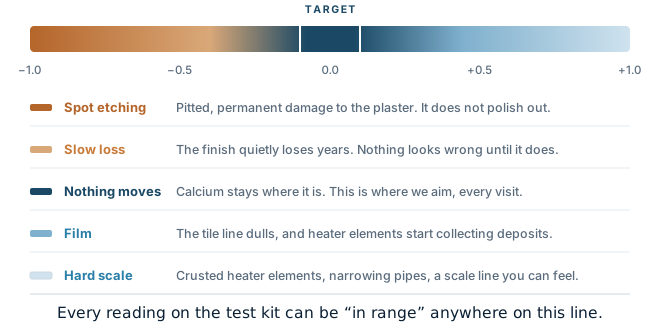
The size of that correction is not small. On a pool carrying 120 ppm of cyanuric acid it can be the difference between water that reads balanced and water that is actively etching the plaster. The worked example is here.
What you're actually paying for
The higher price isn't for a longer visit. It's because we spend less of our time on the mechanical cleaning and more of it on the preventative side: the chemistry and the equipment checks that don't show up as anything visible in the moment, but keep problems from starting in the first place. It's not the right fit for every pool owner. It's how we do it, and it's why the pools we maintain have very few issues.
So when you're comparing quotes, the real question isn't "what does it cost." It's "what do I actually need."
If you're fine with someone showing up once a week to mechanically clean the pool, and you're willing to take a water sample to Leslie's once a month to keep an eye on the chemistry yourself, that's a legitimate way to run a pool, and you know who to hire. It should land on the lower end of the price scale.
If you'd rather never think about your pool and just have it handled, that costs a little more, and the company doing it should carry a contractor's license, certifications from the relevant pool organizations, and technicians whose training didn't end the day they were hired. What counted as current practice in this trade ten years ago isn't current now. The people worth hiring are the ones still keeping up.