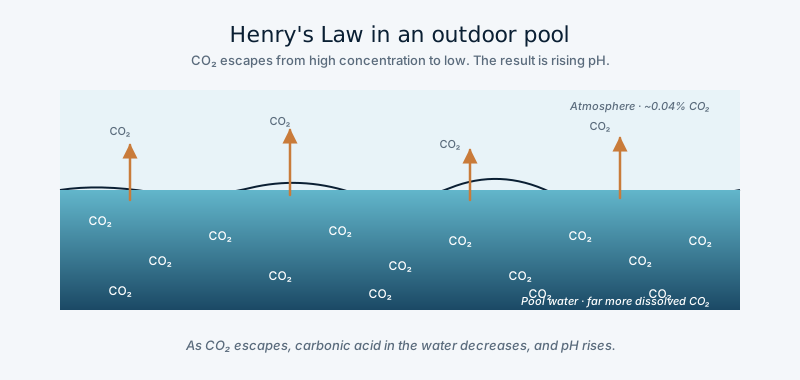
That's because of a chemistry principle called Henry's Law. The short version is that gases dissolved in water want to be in equilibrium with the gases in the air above the water. If there's more dissolved gas in the water than there is in the air, the gas escapes from the water until equilibrium is reached. If there's less, gas dissolves into the water from the air.
This matters because pool water carries a lot of dissolved carbon dioxide (CO₂). The CO₂ in the water forms carbonic acid, and the carbonic acid is what holds the pH down. As long as that CO₂ stays in the water, the pH stays where it is.
But the atmosphere only has about 0.04% CO₂ in it. Pool water has far more dissolved CO₂ than that. So Henry's Law is constantly at work, pulling CO₂ out of your water and into the air. Every CO₂ molecule that escapes means a little less carbonic acid, which means the pH creeps a little higher.
What makes it happen faster
- Heat. Warm water can't hold gases as well as cold water. (Same reason a warm soda goes flat faster than a cold one.) Sunlight on an outdoor pool, every day, drives the temperature up.
- Wind. Moving air at the surface clears away the CO₂-rich layer immediately above the water, increasing the gradient and pulling more out.
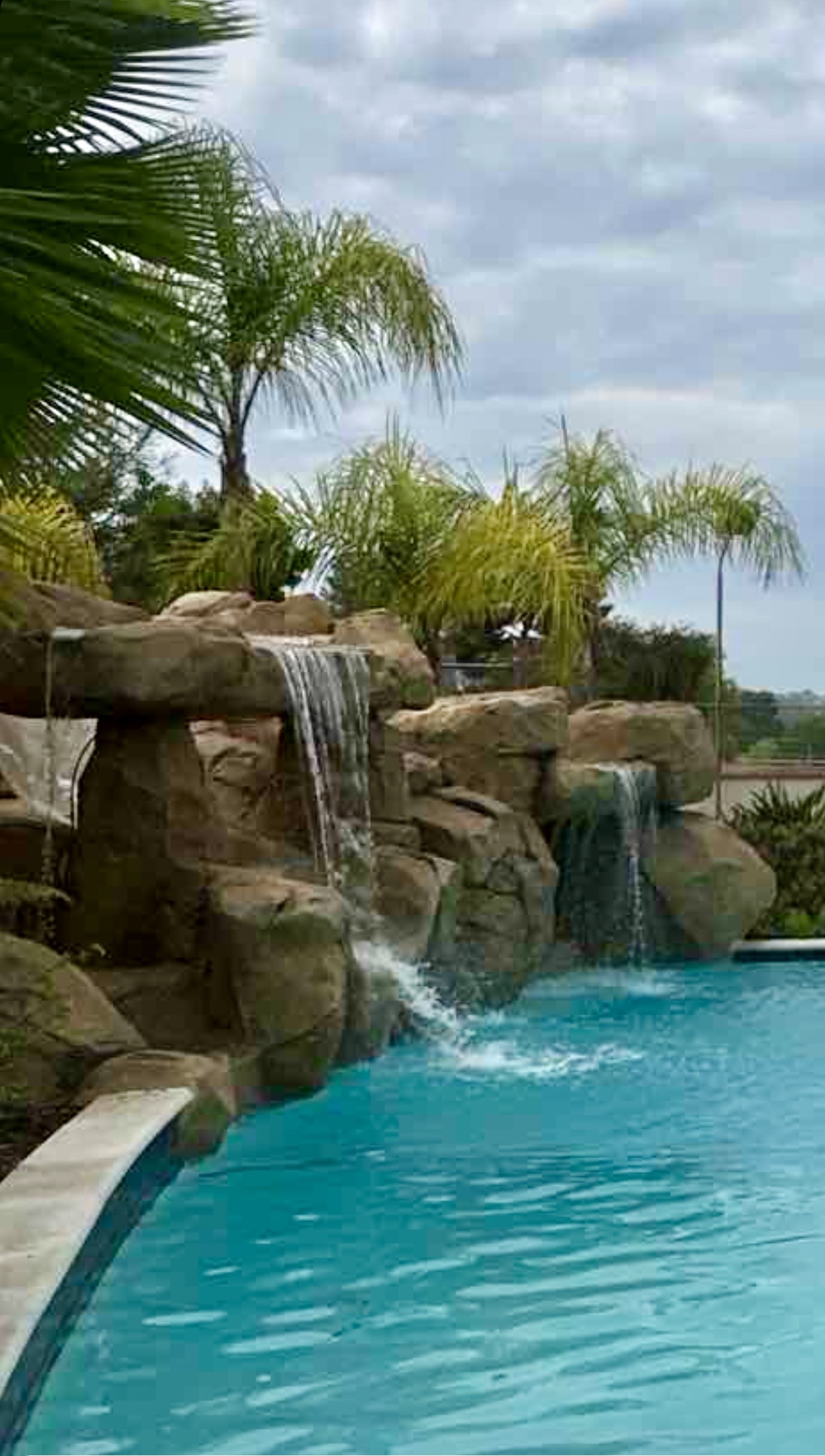
- Surface area and agitation. Waterfalls, fountains, deck jets, swimmers splashing. Anything that increases contact between air and water. Every bubble and every splash accelerates gas exchange.
So an outdoor pool with a waterfall feature, in summer, on a windy day, is essentially a Henry's Law machine. CO₂ is pouring out of the water all day. The pH is climbing whether you want it to or not.
(Henry's Law is also why heated pools lose chlorine and dissolved oxygen faster, and why agitated pools off-gas volatile chloramines more quickly, which is part of why outdoor pools usually need more frequent chemical attention than indoor ones. But the dominant effect, by far, is the CO₂/pH story above.)
Which sets up a fight. The index wants a stable pH. Physics keeps raising it. What most of the industry does about that is the subject of the next page, and it's the wrong answer.